
“The captive's real raw material is the parent's credit rating” - Grant's Interest Rate Observer
Editor’s Note: last week, I stared at a rabbit hole. This weekend, I hopped down it. Over the course of this past week, there was a fair amount of discussion about Nvidia’s credit insurance & captive finance businesses. This was an itch I had to scratch - as banker, I covered GE Capital & GM Financial. I wrapped-up my thoughts below -
CAPTIVE FINANCE.
Last quarter, Nvidia reported operating income of $53.5BN & other income of $15.9BN.
Almost 25% every pre-tax dollar came from marking-up their portfolio of investments.
Without selling anything -
That’s a large - volatile - non-operating component sourced from the same end-market as the operating one.
This isn't a criticism.
It's a classification problem, and classification problems are where most analytical errors begin.
Ask which reference class a situation belongs to, before asking what will happen inside it. The base rates for a chip company and for a financial guarantor are not remotely the same.
A semis analyst asks about ASPs, mix, the next architecture, etc.
A guarantor asks about attachment points, correlation, collateral triggers, and what happens to the asset side when the liability side is called.
What’s unusual & worth calling out about Nvidia is that it’s two things (and not simply flagging it as the Central Bank of AI):
A monoline financial guarantor, selling its credit rating - writing protection on third-party obligations, earning a fee, living or dying on whether the book is diversified. Nvidia's capacity backstops, revenue floors and lease guarantees are functionally this, with the premium taken in kind rather than in cash
A captive finance company, existing to move product by financing the buyer. Historically, analogs included GMAC, GE Capital, and IBM Credit. Nvidia's equity book and its role as originator for the recently announced platforms are functionally this - delivered as equity & guarantees rather than loans, so it never appears as a receivable
Traditionally, a monoline's risk is concentration. A captive's risk is funding.
And both have credit exposure.
Nvidia has taken on a monoline's concentration profile while avoiding a captive's funding profile, and almost everything below follows from that split:
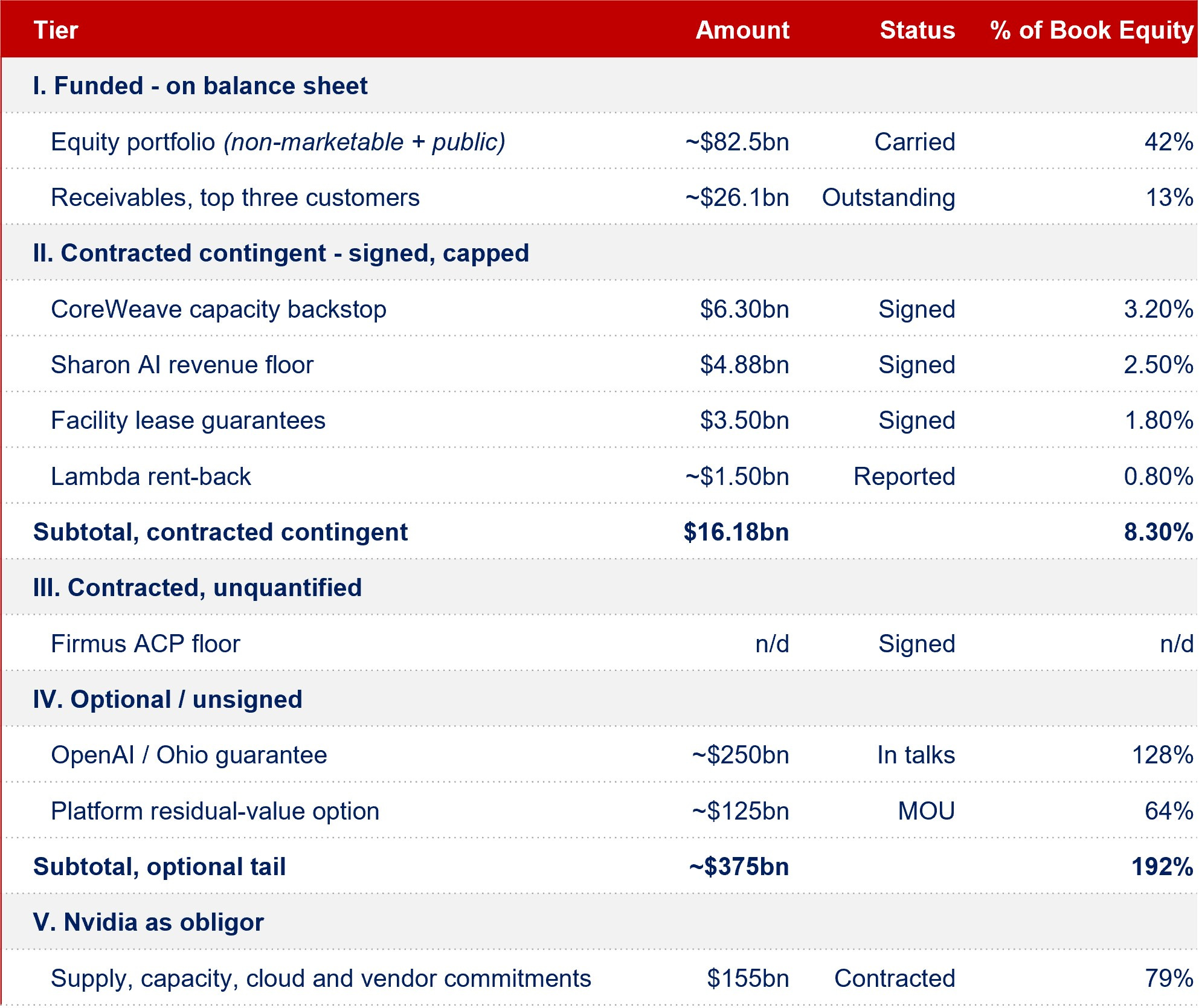
Source: Nvidia Form 10-Q, 26 Apr ‘26; counterparty 8-Ks & press reporting. %s derived against $195.5BN of shareholders’ equity. [Note, I’m skeptical of the OpenAI / Ohio bit] -
The signed, capped contingent book is $16.2BN, or 8.3% of book equity.
The tail everyone is actually worried about is twenty times larger and consists of:
One set of talks; and,
One set of MOUs…
…nothing material is committed -
THE EQUITY BOOK.
Instead of traditional debt financing that captives typically focus on, Nvidia has leaned into direct equity investing in its customers. [for what it’s worth, GE Capital did do this - at a smaller scale - for many years ago, without major issues].
And performance is great.
This book has never seen a down cycle: $5.3BN of unrealized gains against $199MM of cumulative losses and impairments.
The cause for pause is the growth of the book:
Nvidia invested $17.5BN in private companies & infrastructure funds across the whole last year
In the first quarter of fiscal 2027 alone it purchased $18.6BN - against $649MM in the same quarter a year earlier
One quarter exceed last year’s total.
And then there’s OpenAI…
…which most commentary read backwards.
In Sept ‘25, Nvidia announced an LOI to invest “up to $100BN in OpenAI progressively as each gigawatt is deployed.”
By December, the CFO confirmed no definitive agreement existed
The commitment was excluded from data center bookings guidance; by January reporting had negotiations on ice
In Feb ‘26 it was replaced with a $30BN direct equity stake, closing at an $852BN post-money valuation
Read as a retreat, that’s a 70% reduction in exposure.
Read as risk, it’s closer to the opposite.
The LOI was economically a strip of deployment-contingent call options.
Nvidia would fund only as gigawatts came online
If OpenAI deteriorated, Nvidia could simply stop
The optionality sat with Nvidia and cost nothing to hold. The replacement is unconditional equity at a fixed valuation
Nvidia gave up the option and took the position.
The notional fell 70%; the delta went to one -
CREDIT INSURANCE COMP.
On correlation, the analogy holds exactly.
In a world where AI compute demand decelerates, the equity book falls, the capacity backstops trigger, the lease guarantees trigger, the residual support triggers, the receivables deteriorate, the supply commitments become excess inventory, and core product revenue falls.
That’s textbook wrong-way risk: the protection pays out precisely in the states where the protection seller’s own value is impaired.
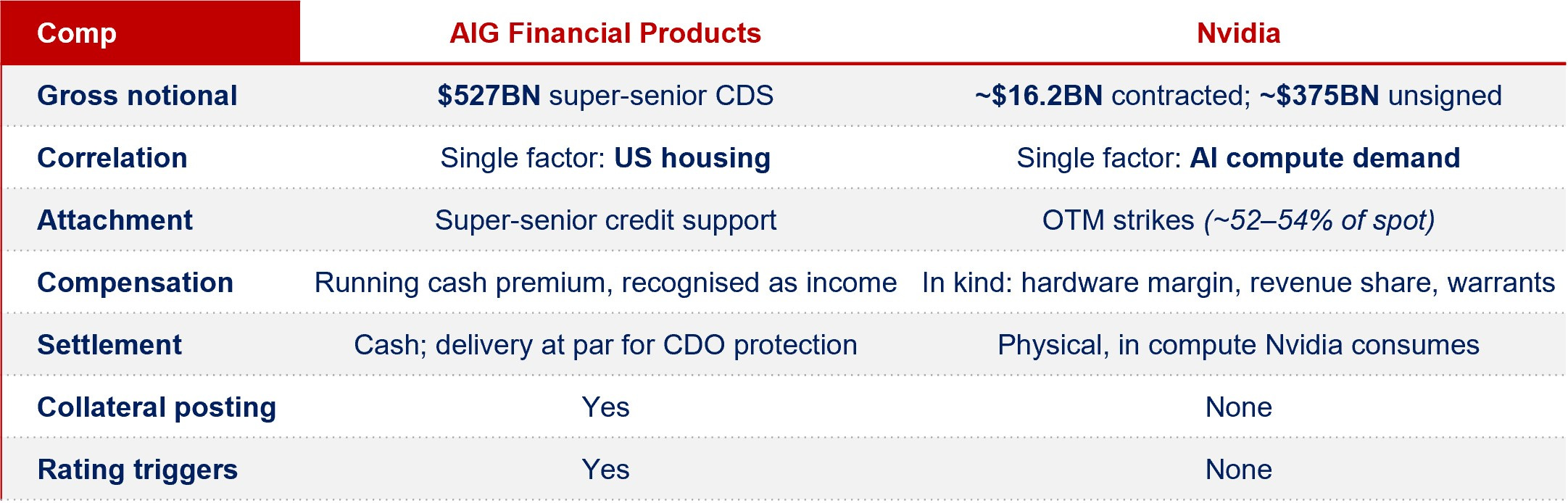
AIG FP & the monolines that failed in ‘08 ran net par outstanding at roughly 100-150x claims-paying resources.
That leverage was the business model.
Nvidia’s contracted contingent notional is 0.1x book equity , and only ~2.0x including the entire unsigned tail.
A sustained 50%-utilisation stress across the signed book costs roughly $13-16BN over six-year windows on a gross cash view: 2-3 weeks of quarterly revenue, before crediting the ~105k GPUs of capacity Nvidia takes delivery of and can use internally, and before the $10BN+ of hardware margin already booked selling those fleets.
The question of capitalization is answered - it’s a non-issue -
THE COMPUTE FACTOR RISK.
On its captive programs (investments & OTC credit derivatives), Nvidia’s risk is really on the residual value of its GPUs.
And that is a derivative of the compute forward curve (demand).
It goes without saying that the current zeitgeist is that we are in a compute shortage - and that demand could not be stronger.
Data supports the narrative:
Coreweave recently signed a contract to rent out (six-year old) Nvidia A100 GPUs into ‘29
Nebius’s earnings call included auctioning their services
CCIR’s research (excellent) shows consistently strong demand
Both for Nvidia’s captive programs & anything beyond Nvidia (GPU-related), the answer to all of this is building a compute factor / beta.
For Nvidia’s exposures, it reasonably straight-forward (as I showed last week via SharonAI example).
The further you get away from those direct relationships, the more likely it will be a regression against historical compute prices / forward curve movements -
THE AI CAPTIVE.
Nvidia is not the Central Bank of AI.
Nvidia is currently the bridge to accelerating the AI buildout.
To Jensen’s credit, he’s figured out how to:
Accomplish being the bridge,
While making money,
In a (financially-speaking) regulatory-light manner
But he can only bridge so-far; that’s what this week’s announcement was about.
Step 1 was finding the capital - check.
Step 2 is finding or bridging the credit insurance (on residual values).
There is a market precedent outside of Nvidia.
Earlier this year, USD.AI partnered with Barker, who underwrote the residual risk, with it being reinsured by Munich Re.
The next step for Nvidia either looks like that at scale, or continuing to onboard that risk & building the world’s largest Captive Finance business -
OTHER NEWS.
Malaysia is booming (you guessed it)
Peter Thiel buys into Argentine Shale
Geopolitics move sideways
Europe heads into winter with 17yr-low gas inventories
Hope y’all had a good weekend -