
"If you are perceived as weak, you invite irrational demands" - Lee Kuan Yew
Editor’s note: if you’re interested in the Venezuelan debt restructuring, I’ve saved down a data-pack spreadsheet; Sanctions Licences & Forward Catalysts are of note -
A NEW DEAL.
Two days ago, President Donald Trump announced what he called the biggest oil deal ever struck.
A new company, formed by the American government and a private operator it has not named, will develop 17 Venezuelan fields containing what Caracas describes as a “proven potential” of 65BN barrels.
Delcy Rodríguez, Venezuela’s interim president, filled in the terms on August 30th:
A 25yr agreement;
$100BN of investment;
More than $209BN of tax revenue for the state; and,
A production target of over 1.5MM barrels per day (b/d).
America takes 55% of effective output and the right to buy oil at cost, for its strategic petroleum reserve and its armed forces.
Its operator remains unnamed, and America’s majors have so far kept their distance.
Rory Johnston, of Commodity Context, offered Canadian viewers a useful corrective on CBC this weekend (politics aside, it was very informative - link here).
The 65BN barrels - he argued - is a red herring. Venezuela already claims the world’s largest proven reserves (dubious, on account of economic recoverability), at north of 300BN barrels, and still pumps barely 1MM b/d (less than a fifth of Canada’s output).
Rory rightly argued that reserves were never the constraint.
Capital & courts were (and are).
What is genuinely new in Trump’s deal is the equity.
Washington’s theory, as Johnston reads it, is that American companies have been expropriated in Venezuela before and will not return without protection; if the American state owns a slice, the investment is de-risked.
Politically (in Venezuelan domestic politics), Johnston suspects the opposite.
And we agree.
Placing the American government on the ownership register of 17 fields in a country with a long history of resource nationalism creates, he says, “a very obvious point of political friction”.
The Venezuelan opposition has already rebuked the deal.
Ricardo Hausmann - a Harvard economist and former Venezuelan planning minister - called it shameful and denied that interim president Delcy Rodríguez has the legitimacy or the constitutional power to sign it.
That objection will recur.
There is also a technical error at the heart of the White House’s sales pitch.
President Trump says the deal more than doubles American reserves and will lower prices at the pump. But “reserves” is doing two jobs.
Proven reserves are barrels in the ground; the Strategic Petroleum Reserve is barrels in salt caverns on the Gulf Coast.
Venezuela produces a heavy, diluted bitumen that is, as it happens, currently unsuitable for storage in those caverns. The barrels are real; the syllogism is not.
For Canada, Johnston’s verdict is calibrated rather than alarmed. Venezuelan heavy crude competes directly with Canadian heavy sour on the American Gulf coast, where Canadian producers have enjoyed an unusually strong position while Venezuela was sanctioned.
More Venezuelan barrels mean an incremental drag: perhaps $4-5 a barrel weaker on Canadian export grades than would otherwise obtain. That is a real cost, not an existential one. Most Canadian barrels land in the Midwest, and Venezuelan crude would have to travel north to contest them.
The subtler risk is psychological.
Ottawa’s trade negotiators have long assumed that Canadian heavy oil is the one export America cannot replace. Johnston does not think this deal changes that arithmetic - doubling Venezuelan output would not displace Canadian barrels - but he does think Washington believes it does, having heard the claim repeated often enough by allied commentators.
Negotiating leverage is partly a matter of belief.
Ottawa may find itself arguing against a fact pattern that does not exist, which is harder than arguing against one that does -
A $240BN PROBLEM.
All of which lands on a country nine years into default and four months into an attempt to escape it.
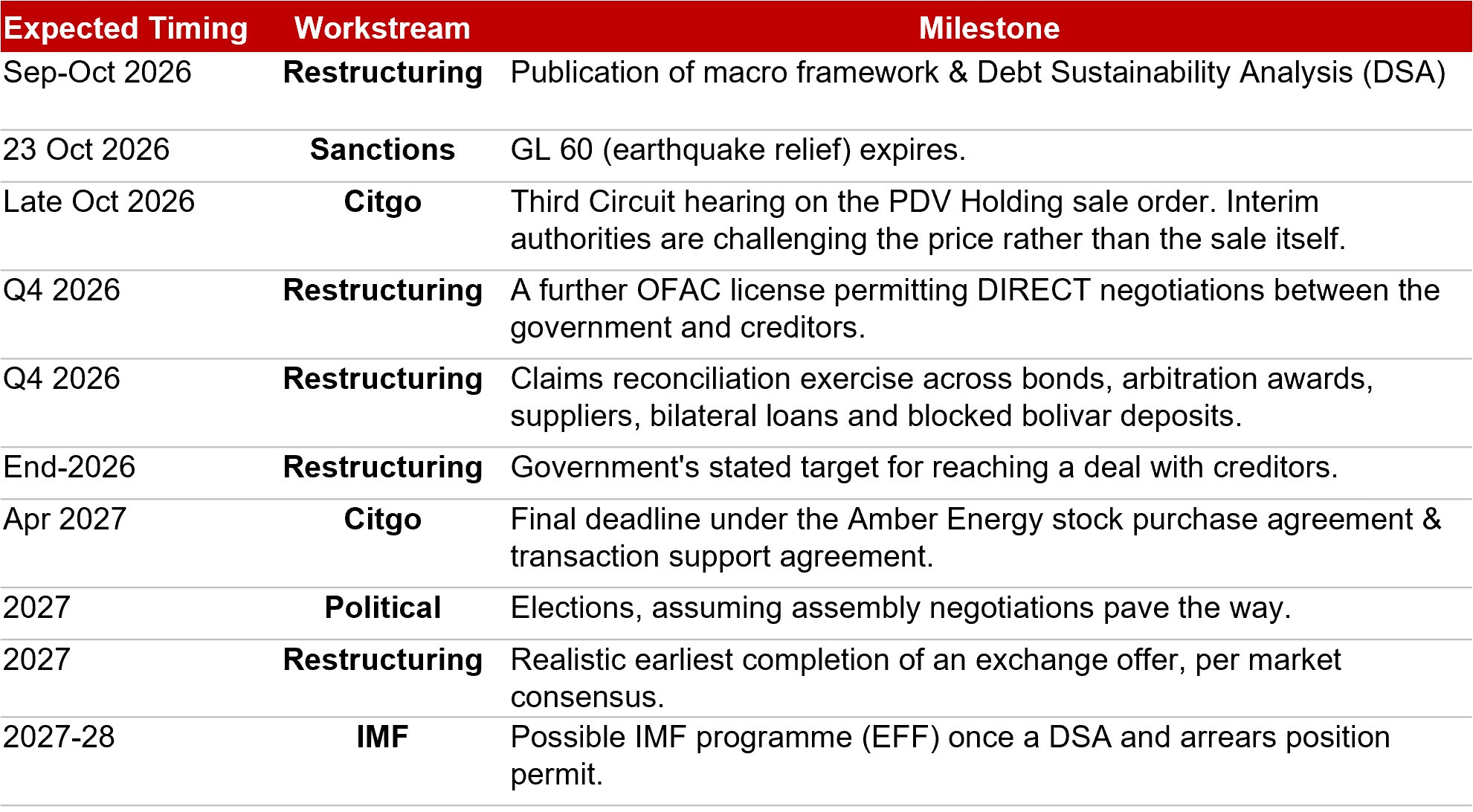
On May 13th, Venezuela, announced a comprehensive restructuring of the Republic’s & PDVSA’s obligations, hiring Centerview Partners (Matthieu Pigasse).
Bondholders are owed over $100BN, with the total debt perimeter and claims reconciliation likely totaling north of $200BN (data-pack link here).
Reconciling it is the mandatory first step, and it took Iraq - the closest sovereign precedent - from ‘05 to ‘08 to implement its deal.
All the while, almost nothing else has moved.
The debt sustainability analysis promised for June was derailed by the earthquakes of June 24th, which killed some 5,400 people & caused damage the World Bank puts at $19.6BN.
Venezuela has chosen a homegrown analysis rather than an IMF programme, seeking access to roughly $5BN of its own reserves at the fund rather than a loan.
Above all, negotiation remains illegal.
General License 58, issued on May 5th, authorizes advisers and nothing else: not settlement, not payment, not direct talks between debtor / creditors.
Issuing new bonds would require amendments to two further licences.
The Venezuela Creditor Committee - Fidelity, T. Rowe Price, Morgan Stanley, GMO, Greylock and Mangart, holding over $10BN - expanded in July in preparation for conversations that it is not even permitted to have -
REFEREE, BANKER, CUSTOMER.
Here, the two stories merge.
In Venezuela, America’s formal vetoes include the authorization of:
Any negotiation and/or agreement;
The issuance of new bonds; and,
The disposal of Venezuelan oil revenues in support of a deal, including oil warrants (because an executive order of January makes it guardian of those revenues, of which perhaps $5-7BN remain)
To that list must now be added a fourth role.
Washington is not merely the gatekeeper of the cash from which creditors must be paid; it is a counterparty taking the barrels - at cost - that generate it.
The tension is not subtle.
Venezuela nets roughly $19 a barrel under the new arrangement against a $65 benchmark.
Trump has said that he does not want a debt deal that bleeds off money he would rather see spent rebuilding the oil industry. That preference has now been converted into contract.
Oil warrants - the standard device for giving creditors upside in a commodity restructuring - are worth less when the upside barrels are already spoken for.
Then there is the courtroom, and the irony.
The interim government’s authority is contested: under Articles 233 & 234 of Venezuela’s constitution a vice-president may act as president for no more than 180 days, that the lapse expired without elections being called, and that Delcy Rodríguez’s acts are therefore void.
And recent precedent in American courts have already shown the instinct: in the PDVSA 2020 litigation, a New York court held that whether PDVSA had authority to pledge Citgo shares was a question of Venezuelan law, because due authorisation is always a matter of local law.
The doctrine that could void a bond exchange could void an oil contract, and vice versa.
Washington now has a direct commercial interest in which way that runs.
Talks between the government and the opposition-led assembly of 2015 began on August 1st, aimed at electoral reform.
No date has been set for a vote; Marco Rubio speaks of “months and weeks, not years”.
Stating the obvious, 2027 is more likely.
Legitimacy is not a philosophical nicety here but the thing that determines whether a restructuring signed in 2027 survives to 2030.
A deal struck by an unelected government, with an American state-owned counterparty holding the best fields on 100yr development rights - a term difficult to reconcile with the 25yr agreement interim president Rodríguez describes - is precisely the deal a future elected government would be tempted to reopen.
Creditors, who have bid the bonds into the mid-50s, are pricing an orderly outcome.
They may get one.
But they should notice that the largest single influence over their recovery is now also the largest single buyer of the oil that funds it, and that it has never been obliged to choose between the two -
OTHER NEWS.
Venezuela weighs leaving OPEC
Venezuela: The reported US business partner
A sharp observation from Benedict Evans
On tokens - noteworthy from Jamin Ball
Next week’s note will likely be back on the topic of compute -